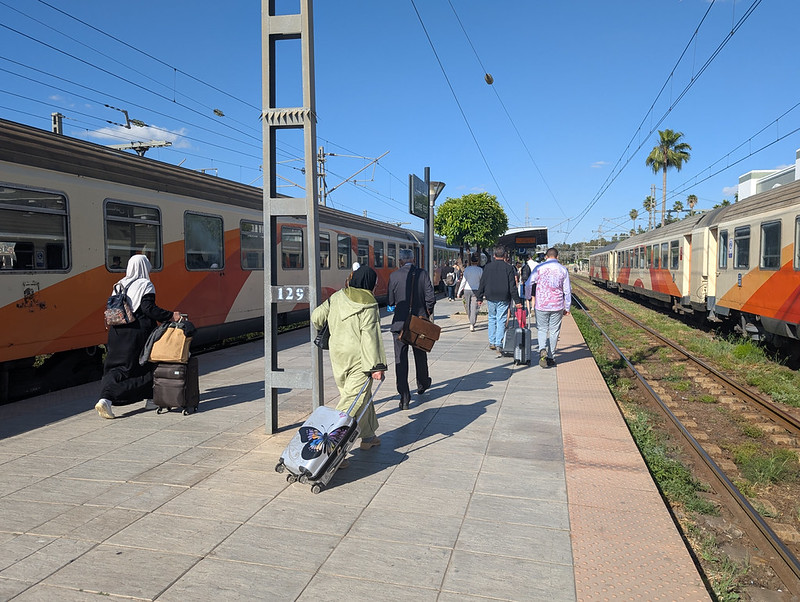

As mentioned in my previous post there are many interesting things to see on Morocco’s rail network. One of my train trips in this wonderful country was from one of the most modern cities in the country, Casablanca, to one of its most historic, Fes.
This route is about 320 kilometres long. It requires taking two trains, changing at the large station at Meknes.
I started at Casa-Voyageurs (Gare de Casa-Voyageurs). This mainly services long-distance intercity trains as one of two central stations in Casablanca. The other, older station, Casa-Port, also has some intercity trains but mainly suburban and commuter trains.

Casa-Voyageurs is a recently-renovated station. Its relatively simple design consists of a large concourse over the top of the platforms with direct entrances and exits on either side. There are shops, ticket offices and plenty of places to sit.

A nice touch is this long balcony that stretches the width of the concourse on the north side. You get great views looking over the tracks below if you peek through gaps in the bushes.
There are chairs and tables and many of the cafes open up onto the balcony. It’s a nice place to sit and have a drink or some food.

Wayfinding and train departure and arrival information was easy to find and understand.
Be aware that as in the rest of the city, hardly anything is written or spoken in English. All the signs are bilingual in French and Arabic. My rusty French and learning a few common Arabic words and phrases was more than enough to get through the trip. So if you prepare just a little bit you shouldn’t have much of a problem finding your way around.

One sight uncommon in Australia was a large number of railway staff around the station. They were positioned at entrances to platforms and at central points throughout the concourse to help people find their way around.
I particularly like their snappy uniforms – another uncommon sight in Australia where we have entirely corporatised outfits of plain polo shirts and baseball caps.

Once through the concourse I headed down the escalator to Platform 7 to catch my train to Fes.
There were a lot of people waiting already. Unfortunately the station architects here seemed to have taken a leaf out of Melbourne’s book for designing platform shelters. There were hardly any shelters or seats on the platform itself, which is a serious omission in a country with Morocco’s climate.

After about 10 minutes a train arrived. It wasn’t the train that I needed but it was an interesting one that I think is worth pointing out.

Delivered over 1983 and 1984, these ‘ZMC’ trains operate medium-distance commuter services out of Casablanca. This particular train ZM 08 was the last of the first delivery round. The design is based on the AM80 ‘Break’ trainsets from Belgium.
There are 14 of these trains in Morocco, which is the only place that this family of trains operate outside of Belgium. You can read more information on the Wikipedia article (in French) here.
Not too long after this had left my train to Fes arrived. It was a very long train hauled by a ONCF E 1400 locomotive. These are of the second-generation Alstom Prima family with variants used in other countries including France, China and India.

The carriages were RA9 ‘Eurofima’. These are from the French rail operator SNCF, originally built in 1977 and refurbished in the 1990s.
One other useful thing to know when travelling is carriage numbers. When you book it will provide you with one on your ticket. But there are very long platforms and there wasn’t any information or indication to tell you at which end you should wait other than small decal stickers that nobody seemed to trust. I ended up hanging around the middle to give me enough time to run to one end of the train if needed.
Turns out that this was a good decision because the decal stickers placed on the platform with the carriage number did not align at all with where the carriages actually stopped.

Inside they looked clean and well-maintained. They have an older layout where there are self-contained compartments of seats with a corridor running down the side of the carriage.

This was fantastic as I don’t believe we have these carriage layouts in Australia anymore other than for some heritage and tourist trains. It certainly makes for a quieter experience and feels a bit special to have your own little enclosed space shared with a couple of strangers.
Unfortunately this corridor exposed one flaw with these carriages. The lack of luggage storage meant that a good portion of the corridor was blocked up with large suitcases and parcels. Although there are overhead shelves in the seating compartments these were not very big.

Inside the compartments were two pairs of three facing seats. This particular one was a first class carriage which I don’t believe is significantly different to those for second class. The main difference is that these have a seat reservation which I was happy to pay a bit extra to guarantee.
There is also a small folding table by the window, coat hooks on the walls and comfortable, thickly-padded seats with armrests and good legroom.


My first impressions of the track infrastructure were excellent. The sleepers and rails looked new and made for a relatively smooth ride. The country’s main lines are also mostly electrified which is fantastic.
Along the way there were terrific views out of the window. I was seated closest to the door which meant I could see out both sides of the carriage.
Passing through the capital city of Rabat and neighbouring Salé gave us a glimpse of the brand new Mohamed IV Tower and infrastructure associated with the upcoming 2030 FIFA World Cup.

As we turned east to head inland, it became drier and more mountainous.
Parts of the countryside reminded me very much of parts of eastern Australia. With some minor differences, this bit outside Meknes could have somewhere on the way to Traralgon or Bendigo.

The network appears to carry a significant amount of goods traffic. There were lots of yards that we passed along the way next to factories and other industrial areas.
The main thing I noticed with these was how clean and tidy they were. No graffiti, up-to-date liveries and well-maintained rolling stock. Considering these were often in the middle of the countryside or on the outskirts of suburban areas this is quite an achievement.

After another hour or two the train finally pulled into Fes. It was a bit confusing looking at this ahead of time because there are multiple railway stations.
The main thing to know is that the main one – just Gare de Fes or Fes-Ville – is where the intercity trains come in. The other stations are for more local trains and some of those heading further east on the diesel track up into the mountains.

It’s a long platform with a pedestrian level crossing at the east end. Another feature of railways around the world that is almost entirely absent in Australia.

After walking through the relatively small station building you come out into a large open plaza that leads into the city.

Fes is divided into three main areas. There are the two historic districts within the medina – Fes el-Bali and Fes Jdid – and the Ville Nouvelle (New City) that was started in the 20th century to allow for new development. Like us, most tourists were headed for the medina which is in the Ville Nouvelle.
There are some public buses to get from the station to the medina but these did not have good reviews from either locals or visitors. Instead the best way is to hop in a taxi for the short trip.

The best advice here is to ignore the taxi drivers directly out the front of the station and walk a minute or two down any of the three streets nearby. Hail a taxi there instead. It’s a good rule to follow in general and applies in many other parts of the world.
As always in Morocco my taxi driver was very chatty and helpful, and did not try to overcharge or scam me. I may expand on this in a later post but I did find a lot of the online commentary about this country to be grossly exaggerated.
If you read and believe much of what is out there you’ll be expecting people to be trying to scam, steal or harass you all the time and in every place. Perhaps I just had amazing luck but it honestly it was not nearly as bad as some people made out. The only incidents I encountered were one aggressive man in the Casablanca Medina (easily warded off by a local restauranteur and his staff) and the odd group in Fes who give you wrong directions.

I will need a lot more space to talk about this beautiful city but the train ride there was very easy, comfortable and cheap. The next time I would see this station would be on my way north to my next stop of Tangier on the high-speed Al Boraq train, but that’s for another time!
Leave a Reply